

Online French classes with a teacher trained in phonetics

From your first word to full fluency

I'm Rohan Murti, an aspiring linguist and a French teacher. I help students clear these French exams:

  • Test d'évaluation de français (TEF)
  • Test de connaissance du français (TCF)
  • Diplôme d'études en langue française (DELF)
  • Diplôme approfondi de langue française (DALF)

I draw on my knowledge of phonetics to work on your pronunciation, and I prepare you for what each exam asks of you. My batches are small, so every student gets individual attention in every class.

Message on WhatsApp
{{ st.value }}{{ st.label }}
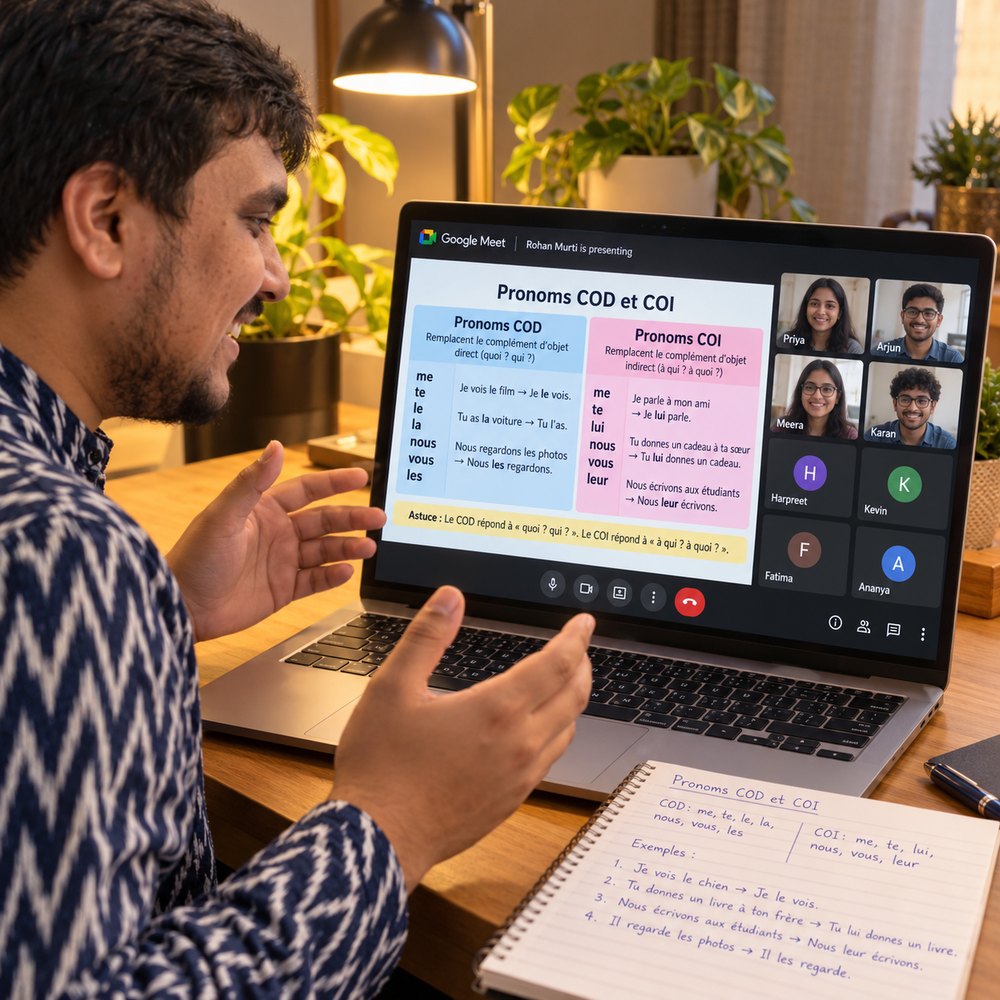
Rohan teaching a live French class to a small batch on Google Meet
Pick your piste

Which French course is right for you?

I've grouped my courses into three pistes, French for "tracks". Pick the one that fits your goal, and you'll see the path I suggest.

{{ activeGoal.name }} ({{ activeGoal.say }})

{{ activeGoal.story }}

{{ activeGoal.title }}

{{ activeGoal.body }}

Suggested path
{{ t.label }}
On any piste: Advanced Pronunciation and Speaking

It's for students who have cleared the DELF B1 but still want to hone their pronunciation. You can join once you've completed B1.2 with me.

Everyone takes the same A1 and A2 courses, whatever exam they're aiming for. The DELF and TEF/TCF batches split at B1.

Inside a class

How my online French classes work

{{ v.title }}{{ v.meta }}
Recordings from my classes on Google Meet. Swipe or use the arrows.

{{ p.text }}

Why I teach in small groups

In a small batch, I hear each of you speak often enough to notice what recurs. Maybe you produce /u/ where French needs /y/, so rue /ʁy/ (street) comes out as roue /ʁu/ (wheel). Maybe you keep forgetting to make the past participle agree. Once I know which errors are recurrent for you, we work on those, and I can tell when they stop. You also get to speak French with other people, not only with me.

The road to B2

From A1 to B2: how long learning French really takes

Each level takes 3 months of classes, and B1 and B2 each have two parts. With the gaps between batches, allow at least a year and a half from your first A1 class to reach B1.2.

Three months is enough to finish A1. Fluency takes longer, and I'd rather tell you that now than later.

Start
B2 after 18 months of classes {{ n.code }} {{ n.month }}

The months on this line count class time only, not the breaks between batches.

{{ lv.code }}

{{ lv.text }}

Upcoming batches

Upcoming French batches

The next A1 batch is a weekend batch starting on 15 November 2026. Join the waitlist, and I'll message you before registrations open.

Level
Starts
Days & time (IST)
Status
{{ b.level }} {{ b.date }} {{ b.days }} Waitlist

Tell me which batch you want

No payment, no call. I message you before registrations open.

Google reviews

What my students say

{{ gbpRating }}

French Kaliké is rated {{ gbpRating }} on Google from {{ gbpCount }} reviews. You can read every one of them on my Google Business Profile.

“
{{ r.text }}
{{ r.initial }}
{{ r.name }}Google review
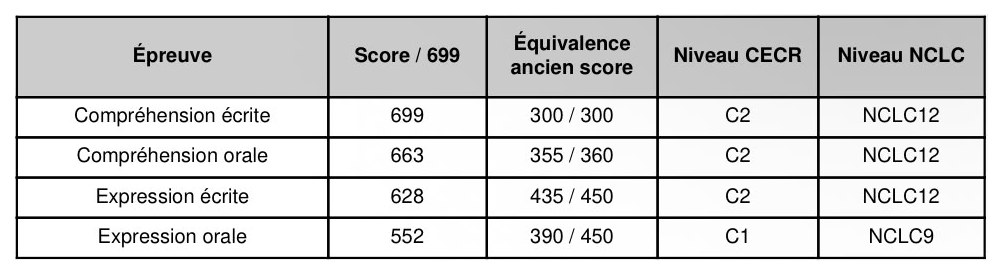
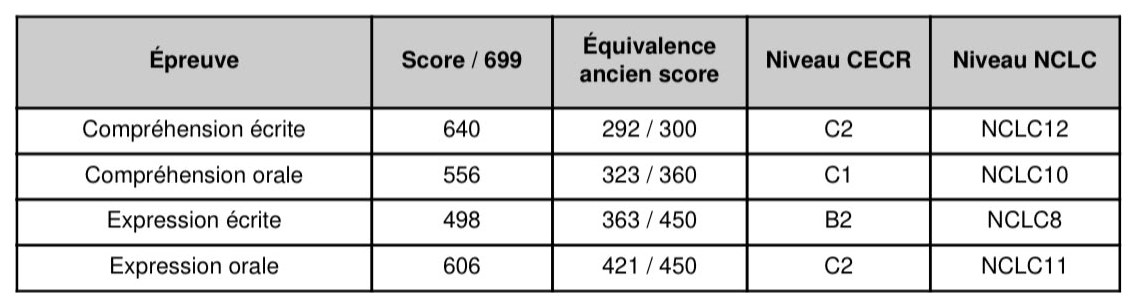
Recent TEF Canada results
TEF Canada result: reading 699 of 699 (C2, NCLC 12), listening 663 (C2, NCLC 12), writing 628 (C2, NCLC 12), speaking 552 (C1, NCLC 9) TEF Canada result: reading 640 (C2, NCLC 12), listening 556 (C1, NCLC 10), writing 498 (B2, NCLC 8), speaking 606 (C2, NCLC 11)
Two of my students' score sheets, names hidden. Tap one to enlarge.
Before you join

Questions people ask before joining

{{ f.a }}

{{ f.linkLabel }} →

Start with a free demo lesson

Watch one of my real lessons first. Message me when it feels right, and I'll help you pick the right batch.

Message on WhatsApp
WhatsAppContact formrohanmurti@frenchkalike.inI reply within 24–48 hours.
About

About French Kaliké

I'm Rohan Murti, the teacher behind French Kaliké. I teach every batch from A1 to C2 myself, so the person you meet in your demo lesson is the person who takes you all the way through.

My background shapes the way I teach. I hold the Diplôme approfondi de langue française (DALF) C2, I've worked as a French medical interpreter, and I'm an aspiring linguist hoping to do a PhD in the field of phonology. In class, that means we look at how French is actually spoken, not only at how textbooks say it should be, and we work on your pronunciation from the very first level. I've taught this way online for more than seven years, to students in India and abroad.

Most of my students prepare for one of three exams:

  • Test d'évaluation de français (TEF)
  • Test de connaissance du français (TCF)
  • Diplôme d'études en langue française (DELF)

They study French for permanent residency (PR) in Canada, for a university place in France, or because the language interests them.

{{ st.value }}{{ st.label }}
Rohan teaching a live French class to a small batch on Google Meet
Your teacher

Meet your teacher

Rohan's route into teaching ran through interpreting, not through a classroom. Working as a French medical interpreter meant carrying meaning between two languages while a patient waited for an answer. That work teaches you where a language breaks down for a speaker, and it teaches you quickly.

My qualifications

{{ q.text }}

Rohan Murti

Why a linguist teaches French differently

I am training as a linguist, so I treat French sounds as a system rather than as a list to memorise. A sound feels difficult to a learner because it does not exist in the language that learner already speaks. Once you know which sound is missing and why, you can build it. That single idea shapes every class I teach.

ಕಲಿಕೆ /kɐlike/learning

What "Kaliké" means

Kaliké comes from the Kannada word kalike, which means "learning". It is pronounced /kɐlike/. I chose a Kannada word because the school teaches French to Indians in their own linguistic terms. The name says so before the first lesson begins.

The method

How I teach French through the sounds of your own language

Every learner struggles with a different set of French sounds, and the set depends on the language they grew up speaking. A Kannada speaker and a Bangla speaker arrive with different problems, so giving both the same correction wastes their time.

A worked example
thé /t̪e/ tea

Take the French word thé, meaning tea. The <th> in thé is not the <th> that a Kannada speaker or a Bangla speaker already produces in their own language. So I do three things, in order.

1

I find the nearest sound in the student's mother tongue and draw the parallel.

2

I explain why the French sound is hard for that particular speaker, which is that the sound is absent from their language.

3

We build the sound together, over repeated attempts.

Compare that with the usual instruction, which is to repeat the word until it sounds right. Repetition without diagnosis leaves the student guessing. A student who understands why a sound is difficult can correct themselves after the class ends, and that is the point. My blog post on the descriptivist approach to teaching French sets out the reasoning at greater length.

Why this matters in the speaking exam

Pronunciation carries marks. An examiner assesses the speaking section of the DELF, the TEF and the TCF. That examiner listens to how you sound, not only to what you say. A student whose vowels and consonants sit close to native French reads as more fluent than their vocabulary alone suggests.

DELF speakingassessed live
TEF expression oraleassessed live
TCF expression oraleassessed live
Inside a class

How the classes actually run

Classes run over Google Meet, which is a deliberate choice rather than a default. Everything a student needs works inside a browser, on an ordinary connection, from any city.

{{ rc.title }}

{{ rc.text }}

Courses

Courses and levels

The courses follow the CEFR ladder, from A1 to C2. The A1 and A2 courses are common to both examination tracks, and the tracks separate from B1 onward.

Each course page sets out the syllabus, the schedule and the fee for that level. The full course list with current batch dates carries the rest.

{{ ld.badge }}
{{ ld.name }}

{{ ld.text }}

Duration{{ ld.dur }}
Each class{{ ld.cls }}
Students

Who I teach

Canada PR · TEF/TCF Study in France · DELF For the love of French

Three groups make up most of my students. The first group prepares for permanent residency in Canada, and those students sit the TEF or the TCF. The second group applies to study in France, and those students sit the DELF. The third group studies French because the language interests them, with no exam in view.

My students are mostly Indian or of Indian origin, and they live across the country and outside it. Choosing between the two Canadian exams confuses most applicants at the start, so I help each of them pick the right one before they start.

Reviews

What students say

Reviews sit on my Google Business Profile and on Reddit, written by students without being asked. Read them there rather than taking my description of them.

{{ gbpRating }}

{{ gbpCount }} reviews on Google

Read the reviews on Google
Straight answers

What I don't do

Four things fall outside what I offer, and stating them saves everyone time.

{{ n.title }}

{{ n.text }}

Try it first

Start with a free demo lesson

Watch a free demo lesson before paying anything. It is a recording of a real class, so you see how the pronunciation work happens, and decide afterwards.

Students who are not ready to book can join the waitlist for the next batch instead. The batch dates stay visible without anyone needing to message me.

Watch a demo or hold a seat

I reply within 24 to 48 hours.

Before you join

Frequently asked questions

{{ f.a }}

Courses

Online French Classes: Courses from A1 to C2

French Kaliké offers online French classes for every level of the Common European Framework of Reference for Languages (CEFR), from A1 to C2, taught live on Google Meet. The courses prepare students for the Test d'évaluation de français (TEF), the Test de connaissance du français (TCF), the Diplôme d'études en langue française (DELF) and the Diplôme approfondi de langue française (DALF). A1 and A2 are common to all exams, and batches split by exam from B1.

{{ courseCountLabel }}
{{ c.badge }}

{{ c.title }}

{{ c.blurb }}

{{ pt.name }}
Duration{{ c.duration }}
Each class{{ c.classLen }}
Exam track{{ c.exam }}

Each course page lists its fee and syllabus.

Before you choose

Questions about exams and preparation

{{ f.a }}

Home/Courses/{{ cc.title }}
{{ cc.badge }} {{ cc.exam }} Small batches

{{ cc.title }}

{{ cc.intro }}

Duration{{ cc.duration }}
Each class{{ cc.classLen }}
PlatformGoogle Meet
Fee{{ cc.fee }}{{ cc.feeTotal }}

Fees are payable in advance and are non-refundable.

Join the next batch

Watch a full recorded lesson before you pay anything.

Starts{{ cc.start }}
Days & time (IST){{ cc.days }}
Batch sizeSmall
Course structure

Month-by-month syllabus

{{ cc.sylNote }}

Part {{ pt.n }}{{ pt.len }}

{{ pt.name }}

{{ mo.label }}
  • {{ it.t }}
[Syllabus: from Rohan]
What you can do at the end

{{ cc.outcome }}

Every class

How my online French classes work

{{ rc.text }}

Is this course right for you?

This course is a good fit if

{{ i.text }}

Another option may suit you better if

{{ i.text }}

Rohan Murti
Rohan Murti DALF C2 · 7+ years teaching

I teach every class myself. Batches are small, so I hear each student speak in every class and can work on their pronunciation.

Other levels

Not the right level?

Questions about this course

{{ f.a }}

Journal

Writing on French sounds, grammar and exams

Notes from the classes, written for students preparing for the TEF, the TCF and the DELF.

⌕
Featured Phonetics & Pronunciation · 11 min read

The descriptivist approach: why "repeat after me" stops working

Repetition without diagnosis leaves a student guessing. Describing the sound — where the tongue sits, and why their language puts it somewhere else — lets them correct themselves after the class ends.

RM
Rohan Murti
12 August 2026
Image placeholder Featured image, 16:10

Get free French phonetics tips

One sound a week, explained through the language you already speak. No sales mail.

Home / Blog / Phonetics & Pronunciation
Phonetics & Pronunciation

The descriptivist approach: why "repeat after me" stops working

RM
Rohan Murti
DALF C2
12 August 2026 · 11 min read
Image placeholder Featured header image, 21:8

A student repeats a word twenty times and it still sounds almost right. Nothing in the repetition tells them what to change, so the twenty-first attempt is a guess like the first.

What repetition leaves out

Imitation works when the learner can already hear the difference. Most cannot, because the ear filters unfamiliar sounds into the nearest familiar category. A French dental t lands in the English t box, and the box is where the problem stays.

Description does what repetition cannot. Naming the position of the tongue turns an invisible target into an instruction the student can follow at home.

Phonetics note

French /t/ is dental: the tongue tip touches the back of the upper teeth. English /t/ is alveolar and aspirated: further back, with a puff of air. Hindi त, Kannada ತ and Bangla ত are already dental.

Diagnosis before drill

Every learner arrives with a different inventory of sounds, and the inventory decides the difficulty. A Kannada speaker and a Bangla speaker need different corrections for the same French word, so a single generic correction wastes both their time.

A student who understands why a sound is difficult can correct themselves after the class ends. That is the point.

A worked example: thé

Take thé, the French word for tea. First, find the nearest sound in the student's first language. Secondly, explain why the French sound is hard for that speaker. Thirdly, build the sound together, over repeated attempts — repetition with a target rather than repetition instead of one.

Language
Sound
Position
French
/t̪/
dental
Hindi / Kannada
त / ತ
dental
English
/t/ (aspirated)
alveolar

Why it shows up in the speaking exam

Pronunciation carries marks. An examiner assesses the speaking section of the DELF, the TEF and the TCF, and that examiner listens to how you sound, not only to what you say. A student whose vowels and consonants sit close to native French reads as more fluent than their vocabulary alone suggests.

What to practise this week

Pick five French words beginning with t. Say each one twice: once with the English t, once with the tongue against the teeth. Record both. The gap between them is the accent you are looking for.

Contact

Ask me anything before you join

I answer every message myself. There is no sales team, so nobody will call you twice a day.

Response time
I reply within 24 to 48 hours with batch dates and next steps.
Where classes happen
Every class is live on Google Meet. Nothing is pre-recorded, and you need nothing beyond a browser.
A note from Rohan

If you are not sure which exam or level to start at, write to me with what you need French for and by when. That is usually enough for me to point you at the right batch, even if it is not one of mine.

RM
Rohan Murti
DALF C2 · French Kaliké

Batch enquiry

Four fields. No account, no call scheduling.

Message on WhatsApp Reply in 24–48 hrs
Google reviews
{{ gbpRating }} ★

Rated {{ gbpRating }} from {{ gbpCount }} Google reviews. Read what students say →

Devoir (homework)

Your devoir

Niveau {{ hw.level }} : {{ hw.batch }} Bonjour, {{ hw.name }}

Here is your homework for tomorrow. It appears at about 4 AM IST the day before it's due. Send me your answers in your batch's WhatsApp group, or by email if I've asked your level to email them. I reply to each of you personally.

Loading your homework…

{{ hwPageErr }}

There's no homework to do right now. Your next devoir appears at about 4 AM IST the day before it's due.

{{ d.label }}

Question {{ c.qno }}

{{ g.t }}

Upcoming batches

Ready for the next level?

Level
Starts
Days & time (IST)
Status
{{ b.level }} {{ b.date }} {{ b.days }} Waitlist
Devoir (homework)

Open your devoir

Enter your name and the mot de passe (password) I sent you. You'll see the homework for your batch.

Lost your mot de passe? Ask me in your batch's WhatsApp group.

Free tools

Practise French for free

Play Gramle, practise your conjugations, or build your vocabulary with the French glossary.

French Kaliké

Live French classes on Google Meet, taught by Rohan Murti.

Menu
Courses
© 2026 French Kaliké
Next A1 batch · starts 15 Nov Watch a full recorded lesson before you pay anything.